

Trump administration officials told congressional staff in private briefings on Sunday that U.S. intelligence did not suggest Iran was preparing to launch a preemptive strike against the United States interests, four people familiar with the briefing told ABC News.
The officials said there was more of a general threat in the region from Iran’s missiles and proxy forces, sources told ABC News.
The intel shared with staff appears to contradict some of President Donald Trump and the White House’s previous statements about Iran and the reasoning for attacking the country.
The president said in his video address announcing the strikes, “our objective is to defend the American people by eliminating imminent threats from the Iranian regime.”
On a call with reporters this weekend, senior Trump administration officials said there were indicators that Iranians could launch a preemptive attack against U.S. forces and allies in the region.
While Trump was meeting with military leaders this weekend, he spoke with ABC News about the general threat from the Iranian regime.
“I think there was a threat. Had we not done Midnight Hammer, which was one of the greatest things [this] country has ever done, we would’ve been faced with a nuclear weapon within a month — we would have been faced with a very powerful nuclear weapon within a month,” Trump said this weekend.
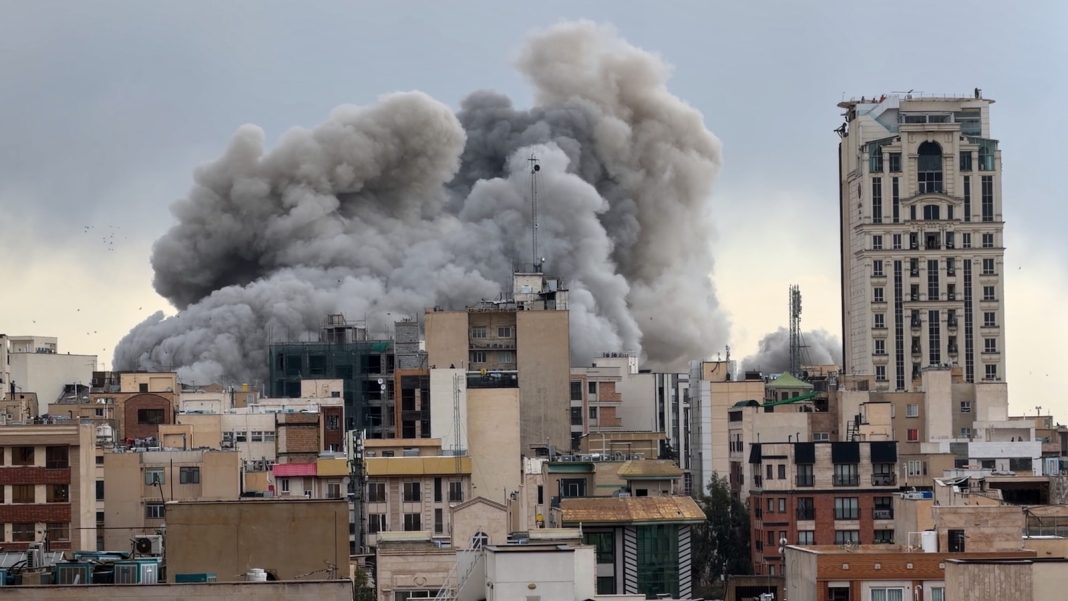
A plume of smoke rises after a strike in Tehran, Iran, March 2, 2026.
Mohsen Ganji/AP
“And then they were trying to build back –not there because that area was obliterated, but they were working on another site despite the negotiations — which at some points were going very well,” Trump continued. “But in the end we didn’t think they were going to get there [in terms of negotiations]. And they would’ve had in a fairly short period of time some very fairly big nuclear capacity and we were not going to put up with that.”
During a press briefing Monday, Defense Secretary Pete Hegseth said the attack was a response to Iranian aggression against the U.S. over a number of years.

Defense Secretary Pete Hegseth speaks during a press conference on US military action in Iran, at the Pentagon in Washington, March 2, 2026.
Brendan Smialowski/AFP via Getty Images
“We didn’t start this war, but under President Trump, we are finishing it. Their war on Americans has become our retribution against their Ayatollah and his death cult,” Hegseth said. “It took the 47th president, a fighter who always puts America first, to finally draw the line after 47 years of Iranian belligerence.”
The U.S. and Israel launched an attack on Israel on Saturday, killing Iranian Supreme Leader Ayatollah Ali Khamenei in Tehran. Trump told Fox News’s Bret Baier on Monday that 49 senior leaders were killed in the initial strikes.

Smoke plumes billow following Israeli bombardment on Beirut’s southern suburbs, March 2, 2026.
Ibrahim Amro/AFP via Getty Images
Following the start of the U.S.-Israel operation, Iran launched retaliatory strikes with missile and drone attacks targeting Israel, regional U.S. bases and Gulf nations.
The conflict has resulted in at least four deaths of U.S. servicemembers so far, but military officials said Monday more deaths are expected.
“We expect to take additional losses,” Gen. Dan Caine, the chairman of the Joint Chiefs of Staff, said during a briefing. “And, as always, we will work to minimize U.S. losses. But as the secretary said, this is major combat operations.”
Caine did not specify a timeline, but said, “This is not a single overnight operation. The military objective … will take some time to achieve.”
Trump told CNN’s Jake Tapper that the U.S. military is “knocking the crap” out of Iran — but the “big wave” is yet to come.
“We haven’t even started hitting them hard. The big wave hasn’t even happened. The big one is coming soon,” Trump told Tapper Monday morning.
CNN was the first to report on what the Trump admin told congressional staff.
–ABC News’ John Parkinson and Fritz Farrow contributed to this report.