

Iranian Foreign Minister Abbas Araghchi told ABC News on Sunday that no country’s leader has the right to tell Iran not to respond to the sort of strikes carried out against it by the United States when asked about an overnight social media post from President Donald Trump that said that Iran should not retaliate.
Trump had written on his social media platform early on Sunday, “Iran just stated that they are going to hit very hard today, harder than they have ever hit before. THEY BETTER NOT DO THAT, HOWEVER, BECAUSE IF THEY DO, WE WILL HIT THEM WITH A FORCE THAT HAS NEVER BEEN SEEN BEFORE!”
“I don’t think any leader of a country has the right to say so. No. We are defending ourselves, and we have every right, every legitimate right, to defend ourselves, Araghchi told ABC News’ “This Week” anchor George Stephanopoulos. “What we are doing is the act of self-defense. There are huge differences between these two.”
“So one should tell, you know, the president of the United States, ‘Do not attack. Do not make any aggression against another country.’ But nobody can tell us that you don’t have any right to defend yourselves,” Araghchi added. “We are defending ourselves; whatever it takes; and we see no limit for ourselves to defend our people, to protect our people.”
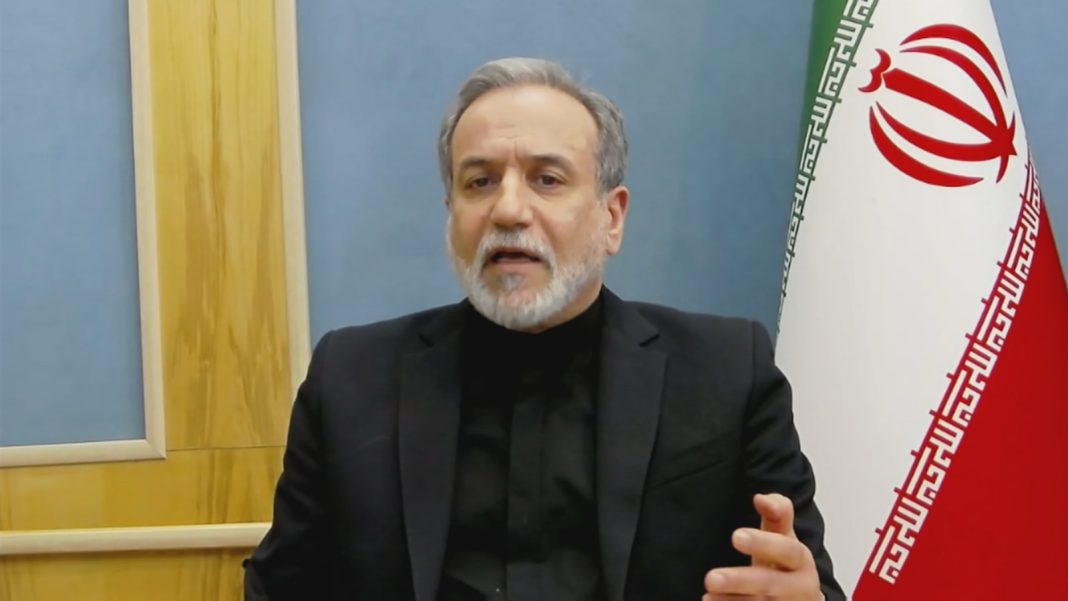
Iranian Foreign Minister Abbas Araghchi appears on ABC News’ “This Week” on March 1, 2026
ABC News
Asked by Stephanopoulos how much damage the attacks have done on Iranian military infrastructure, Araghchi said, “Well, we have lost some commanders, that is a fact, and the names are already announced. But another fact is that nothing has changed in our military capability.”
Araghchi said Iran was able to start retaliating after Saturday’s attack even faster than it could during its 12-day conflict with Israel in 2025.
“So our military is in place. They are capable enough to defend our country,” Araghchi said. “Even more, they are more prepared and capable than [the] previous war before, [the] 12-day war, quality-wise, quantity-wise, they are in a better position. And you have seen how they acted so far.”
Stephanopoulos asked Araghchi if a negotiated settlement with the U.S. was still possible.
Araghchi responded, “Well, you answer this question. We negotiated with the United States twice in the past 12 months, and in both cases, they attacked us in the middle of negotiation, and that has become a very bitter experience for us,” Araghchi said.
Araghchi pointed out how negotiations had been going on between the U.S. and Iran in June ahead of the Israeli attack on Iran, and said that negotiations that had been going on with Omani mediation had been making progress, and “a deal was at our reach, and we left Geneva happily with the understanding that we can reach a deal next time we meet.”
“And it was very unfortunate that those who are against peace, against diplomacy, against negotiation, when they understood that diplomacy is going on well, they decided to spoil it, and they created a buildup in the media, against the Islamic Republic of Iran … And they made lots of accusations against us. They made, they created false information and disinformation. And they finally get to their, you know, to what they wanted. They dragged President Trump, they convinced President Trump to attack us unprovoked and unwarranted.”
Araghchi also said that Iran had begun following its procedures with a transitional council and electing a new supreme leader when asked by Stephanopoulos who is currently in charge in Iran.
Pressed by Stephanopoulos earlier over the high estimates of how many Iranians were killed while protesting the Iranian government over the past few months, Araghchi pushed back, alleging that Iran was faced with a “terrorist operation” which tried to increase the death toll during protests, allegedly under Israel’s instruction. Araghchi did not provide evidence for that claim.
More than 7,000 people were killed during the crackdown on protests, and more than 11,000 deaths are still under review, according to HRANA, the Human Rights Activists News Agency.
“It was first protesters, demonstrations, demonstrations, which was legal; according to our constitutions, our people have the right to protest and to go for gatherings and demonstrations … They did it from 28th December to 7 January, we had legal protests. Everything was fine, and nobody was killed,” he said. “And then on 8th January to 10, we faced with a terrorist operation. Armed elements were added to this question, and they started to shoot at our police forces, our security forces, and then they started to shoot at ordinary people, even to protesters. Why? Because they wanted to increase the number of deaths since the president of the United States had already said that if there are killings, he will come to, he would come to rescue. So they wanted to actually drag him to this question.”
He also said that if anyone claims the number of those killed is more than what the Iranian government has said, “Please show one evidence. Please add one more name to the list we have already published.”
Stephanopoulos asked Araghchi if Iranians celebrating in the streets after Ayatollah Khamenei’s killing are subject to the same kind of discipline. Araghchi did not answer that question, and continued to allege that Israel had ordered killings and shootings in Iran during the protests.